

In general, there are four popular ways that machines Learn. There is supervised learning, where the machine works with labeled data, then unsupervised learning, where the machine works with unlabled data. Then there's reinforcement learning, where the machine learns by getting a reward. There's also semi-supervised learning, which is a mix of unsupervised and supervised. Each of these have different strengths and weaknesses, but before you see those let's take a look at how people learn.
How People Learn
People learn in all sorts of ways — through reading, listening, observing, sensing, feeling, playing, interacting, comparing, experiencing, reasoning, teaching, trial and error, and so on. Psychic Edgar Cayce claimed he learned how to spell by sleeping with his spelling book under his pillow, an unconventional form of human learning. And all of those learning methods I just mentioned merely scratch the surface. Scientists are still trying to learn how the brain works and identify the many ways the brain functions to learn new things, a pursuit that overlaps with understanding AI and ML.
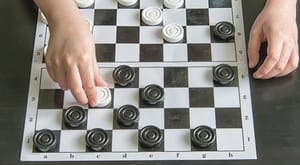
Imagine you want to learn how to play checkers. You could do this in several different ways. You could hire a tutor, who would introduce you to the game, teach you how to move the checkers, and show you some winning strategies, much like a supervised learning algorithm. You could practice by playing against the tutor, who would supervise your moves and perhaps correct you when you make a mistake. As you increase your mastery of the game, you would then be able to play without supervision and even develop your own strategies, similar to how regression models in ml become more accurate over time.
Another option would be to watch people play checkers. By closely observing how others play the game, you could probably figure out how to move the checkers, how to jump an opponent's checkers, how to earn a crown, and so forth, similar to how ai and machine learning can learn from examples. You would probably also start to identify different strategies for winning.
You might even try a combination of these two approaches. A tutor would bring you up to speed on the basics — how to set up the board, move the checkers, jump an opponent's checkers, earn a crown, and so forth — and then you'd observe other people playing, a process similar to supervised learning algorithms in ml. You'd have a high-level overview of the game, but you'd rely on your own observations to learn new strategies and improve your game.
Supervised learning, Unsupervised Learning and Semi-Supervised Machine Learning

The three ways to learn to play checkers are very similar to how machines often learn, particularly in ai and ml:
- Supervised learning: With supervised learning, you feed the machine labeled data, so the machine can figure out how to classify the data. For example, you feed the machine a picture of an apple and tell it, "This is an apple." You feed it a picture of a banana and say, "This is a banana." You proceed with a dozen other fruits. The next time you feed the machine a picture of a piece of fruit, the machine can tell you what it is — a banana, an apple, grapes, cherries, whatever — assuming it was included in the training data. If it delivers a wrong answer, you correct it, and it learns from its mistakes, becoming more accurate with more practice.
- Unsupervised learning: With unsupervised learning, you feed the machine a set of data, and it discovers patterns in that data on its own and figures out its own rules for interpreting the data. For example, you feed it pictures of all sorts of fruit without telling it, "This is a banana. This is an apple. These are grapes." The machine learning application determines how to cluster the pictures. Maybe it groups them according to color, maybe by size, maybe by shape, or maybe by some other characteristic you would never have imagined.
- Semi-supervised learning: This approach combines supervised and unsupervised learning. You train the machine just a little bit so it gets a high-level overview, then the machine develops its own rules and strategies based on its examination of the data, akin to how ai and ml systems function.
Reinforcement Learning
Reinforcement learning is a technique that involves rewarding the machine for its performance. Reinforcement learning has its roots in operant conditioning — the principle that behavior followed by pleasant consequences is likely to be repeated, and behavior followed by unpleasant consequences is less likely to be repeated. With reinforcement learning, a reward is associated with a certain action or occurrence, and an environment is created in which the machine attempts to maximize its cumulative reward.
In 2013 Google's DeepMind project produced an application of reinforcement learning its developers called Q-learning. In Q-learning, you have a set environments or states typically represented by the letter "S," possible actions that can respond to the states represented by the letter "A," and quality of performance represented by the letter "Q."
Suppose you have an Atari game like Space Invaders that requires you to blast aliens with your laser cannon as they descend from the sky. To help the computer learn how to play, you might have S represent the number of aliens descending and the speed of descent and A represent actions the computer takes to shoot aliens out of the sky, thus improving Q, which represents the score of the game. Each time the computer successfully shoots down an alien, it's rewarded with an increase in Q. The machine plays the game repeatedly and, attempting to maximize Q, becomes much more adept at shooting down aliens.
Reinforcement learning, specifically Q-Learning, enables machines to quickly grow beyond our understanding. It can help you skip the steps required for collecting data and then feeding the machine training data and test data, streamlining the machine learning application process. The machine essentially creates its own data as it engages in iterative trial and error.
While supervised, unsupervised, semi-supervised, and reinforcement learning are the primary ways machines learn, stay tuned for more to come. Experts in artificial intelligence (AI) are constantly working on developing new approaches to machine learning and understanding how to combine different techniques.
Frequently Asked Questions
What are the different types of machine learning (ML)?
The three main types of machine learning are supervised learning, unsupervised learning, and reinforcement learning. Each type uses different methods to learn from data and make predictions.
How does supervised machine learning work?
Supervised machine learning involves a machine learning algorithm that learns from labeled data to make predictions on new data. This form of machine learning requires input data that includes both the input variables and the corresponding output.
What is unsupervised machine learning?
Unsupervised machine learning uses algorithms to analyze and learn from unlabeled data. It identifies patterns and structures in the data without predefined labels.
What role does a machine learning algorithm play in Artificial intelligence (AI)?
Machine learning is a key component of AI. It enables the system to learn from data, recognize patterns, and make predictions or decisions without being explicitly programmed for each task.
What is deep learning?
Deep learning is a subset of machine learning that uses neural networks with multiple layers to learn from large amounts of data. It is very effective for tasks like image recognition and natural language processing.
How is a machine learning model trained?
A machine learning model is trained by exposing it to a data set where it learns the relationships between input data and desired output. The training process involves adjusting the model’s parameters to minimize prediction errors.
What skills does a machine learning engineer need?
A machine learning engineer needs skills in programming, data analysis, and knowledge of machine learning algorithms.
They should be proficient in using large amounts of data and be familiar with platforms and tools used to build and deploy machine learning models.
How do recommendation engines use machine learning?
Recommendation engines use machine learning to analyze user behavior and preferences. By learning from this data, they can make personalized recommendations for products, services, or content to users.

This is my weekly newsletter that I call The Deep End because I want to go deeper than results you’ll see from searches or LLMs. Each week I’ll go deep to explain a topic that’s relevant to people who work with technology. I’ll be posting about artificial intelligence, data science, and ethics.
This newsletter is 100% human written 💪 (* aside from a quick run through grammar and spell check).
more sources
- https://stackoverflow.com/questions/7289521/supervised-learning-with-multiple-sources-of-training-data
- https://www.ibm.com/topics/supervised-learning
- https://en.wikipedia.org/wiki/Supervised_learning
- https://cloud.google.com/discover/what-is-supervised-learning
- https://www.researchgate.net/publication/359609914_Sources_of_Understanding_in_Supervised_Machine_Learning_Models
- https://www.datacamp.com/blog/introduction-to-unsupervised-learning
- https://www.ibm.com/topics/unsupervised-learning
- https://www.reddit.com/r/datascience/comments/1b4as8w/unsupervised_learning_sources/
- https://cloud.google.com/discover/what-is-unsupervised-learning
- https://en.wikipedia.org/wiki/Unsupervised_learning
- https://github.com/hzm2016/sources-of-reinforcement-learning