


There are several commonly used machine learning algorithms and it's difficult to choose the right one based on the use cases and other factors.
But you are not limited to using only one machine learning algorithm in a given application. You also have the option of combining algorithms through various techniques referred to collectively as ensemble modeling.
One option is to combine the outcomes of two or more algorithms. Another option is to create different data samples, feed each data sample to a machine learning algorithm, and then combine their predictions to make a final decision. In this post, I explain the three approaches to ensemble modeling. There is bagging, boosting, and stacking.
Bagging

Bagging involves combining the outputs from two or more algorithms with the goal of improving the accuracy of the final output. Here's how it works in supervised learning:
- Two or more data sets are created; for example, by taking two random samples.
- Each data set is fed to a classifier algorithm; for instance, a decision tree algorithm.
- The machine creates two different decision tree models, each based on a different data set. Given a test sample, these decision trees may produce different outputs.
- The machine combines those outputs to make a final decision. Using different algorithms can help improve accuracy. A common way to combine these outputs is by majority voting, or taking average of different decisions.
The bagging approach results in reduction of variance, which in turn may improve the overall accuracy of the output in comparison to using a single tree.
Boosting
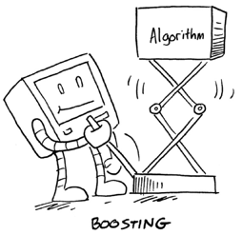
Boosting involves one or more techniques to help algorithms accurately classify inputs that are difficult to classify correctly. One technique involves combining algorithms to increase their collective power. Another technique involves assigning the characteristics of challenging data objects greater weights or levels of importance. The process runs iteratively, so that the machine learns different classifiers by re-weighting the data such that the newer classifiers focus more on the characteristics of the data objects that were previously misclassified.
Like bagging, boosting results in reduction of variance, but boosting can be sensitive to outliers. These are inputs that lie outside the range of the other inputs. Adjusting for the outliers in a regression model may actually reduce its accuracy.
Stacking
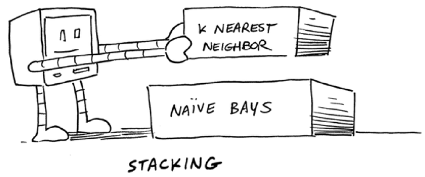
Stacking involves using two or more different machine learning algorithms (or different versions of the same algorithm) and combining their outputs using another meta-learner to improve the classification accuracy.
The team that won the Netflix prize used a form of stacking called feature-weighted linear stacking. They created several different predictive models and then stacked them on top of each other. So you could stack K-nearest neighbor on top of Naïve Bayes. Each one might add just .01% more accuracy, but over time a small increase in accuracy by several models can result in significant improvement. Some winners of this machine learning competition stacked 30 algorithms or more!
Conclusion
Think of ensemble modeling as the machine learning version of "Two heads (or three) are better than one." Each of the techniques I describe in this post involve combining two or more algorithms to increase the total accuracy of the model. You can also think of ensemble modeling as machine learning's way of adding brain cells. Keep in mind, however, that you need to give careful thought to how you combine the algorithms. Otherwise, you may end up actually lowering the machine's prediction abilities.
Frequently Asked Questions
What is an ensemble learning method in machine learning?
An ensemble learning method in machine learning involves combining the predictions of multiple machine learning models to improve the overall performance and accuracy of the final predictive model.
How does ensemble learning improve the performance of a machine learning model?
3 Key Benefits of Ensemble Learning:
- Improved Accuracy: Ensemble learning combines the strengths of multiple models to reduce errors.
- Balanced Weaknesses: By combining models, ensemble learning balances out the weaknesses of individual models.
- Enhanced Performance: This approach improves the overall performance of machine learning models.
Ensemble learning is a way to make machine learning models better. It does this by using the strengths of many models together, which reduces the chances of errors.
When we use a combination of models together, we can balance out the weaknesses of each individual model. This makes the overall model stronger.
What are some common types of ensemble methods?
Common types of ensemble methods include Bagging (e.g., Random Forest), Boosting (e.g., AdaBoost, Gradient Boosting), and stacking. These techniques use different approaches to combine multiple models that create a strong predictive model.
Can you explain the difference between a base model and an ensemble model?
A base model is a single model used to make predictions.
An ensemble model is a group of base models that work together. They share their predictions to get a more accurate result. Using a comprehensive guide to ensemble models in machine learning can aid in this process.
Why Ensemble Models are Better?
Here are four reasons why ensemble models are better:
1. More Accurate: Ensemble models are more accurate than base models.
2. More Reliable: They are also more reliable because they use many models.
3. Better Decisions: Ensemble models help us make better decisions.
4. Improved Results: They improve overall results by combining many predictions.
What is the role of a neural network in ensemble learning?
In ensemble learning, a neural network can be used as one of the base models.
By combining the predictions of a neural network with those of other models, an ensemble learning technique may get better results than any single model.
How do you train multiple machine learning models for ensemble methods?
To get the most out of combining multiple machine learning models, each model needs to be trained separately. This means using the same or different parts of the data for each model. Sometimes a regression model is used for one part and a classification model for another.
It's important for the models to be different from each other. Using different algorithms can help achieve this. This is key to making the combination of models work well. If the models are too similar, the combination won't work as well.
What is a voting ensemble and how does it work?
A voting ensemble is an ensemble method where multiple models make predictions. The final prediction is determined by a majority vote or average of the predictions. This technique is straightforward but effective in combining the strengths of different models.
When should you use ensemble learning?
When you want to make your model better, you should use ensemble learning techniques. This helps to make predictions more accurate. It also helps to stop the new model from overfitting. This is especially helpful when you're working on a complex task and one model can't do a good job on its own. Several models can be combined to improve performance.
Can you combine models from different machine learning methods?
Yes, combining models from different types of machine learning methods is a common practice in ensemble learning. For example, you can combine linear models, neural networks, and support vector machines to create a comprehensive and powerful ensemble model.

This is my weekly newsletter that I call The Deep End because I want to go deeper than results you’ll see from searches or LLMs. Each week I’ll go deep to explain a topic that’s relevant to people who work with technology. I’ll be posting about artificial intelligence, data science, and ethics.
This newsletter is 100% human written 💪 (* aside from a quick run through grammar and spell check).
More sources
- https://www.sciencedirect.com/topics/computer-science/ensemble-modeling
- https://en.wikipedia.org/wiki/Ensemble_learning
- https://builtin.com/machine-learning/ensemble-model
- https://www.datacamp.com/tutorial/ensemble-learning-python
- https://www.ibm.com/topics/ensemble-learning
- https://www.simplilearn.com/tutorials/machine-learning-tutorial/bagging-in-machine-learning
- https://www.datacamp.com/tutorial/what-bagging-in-machine-learning-a-guide-with-examples
- https://en.wikipedia.org/wiki/Bootstrap_aggregating
- https://www.javatpoint.com/bagging-machine-learning
- https://www.geeksforgeeks.org/ml-bagging-classifier/
- https://interactivechaos.com/es/manual/tutorial-de-machine-learning/stacking
- https://machinelearningmastery.com/stacking-ensemble-machine-learning-with-python/