


The Imitation Game is a 2015 movie based on the biography of Alan Turing, a Cambridge and Princeton graduate. In 1939, Turing was recruited by the newly created British intelligence agency MI6 to decipher Nazi codes, including Enigma. The Polish had broken the Enigma code before the war, but the Nazis increased the complexity of their Enigma machines, so there were approximately 10114 permutations to the code. At the time, the British code-breaking operation involved 12,000 people who covered three shifts that operated 24/7. Turing and his team built an electromechanical machine called the Bombe that searched through the permutations of the Enigma code to find the one that was used for each message. Using the Bombe, the British were able to read all of the German navy's encrypted messages.
While working toward his Ph.D. at Princeton, Turing published a paper entitled "On Computable Numbers with an application to the Entscheidungs problem," in which he envisioned a single, universal machine that could solve any problem by following instructions that could be encoded on a paper tape. For example, given one set of instructions, the machine might be able to calculate square roots. Given another set of instructions, it could solve crossword puzzles. Although others have been credited with inventing the first computer, Turing's ideas gave birth to the field of computer science, specifically computer programming.
Testing a Machine to Determine Whether It Is Intelligent

In a 1951 paper, Turing proposed a test for intelligence called the “imitation game,” which is based on a Victorian parlor game. The game involves three players. Player A is a man, Player B is a woman, and Player C is a man or woman who acts as the interrogator. Player C cannot see Players A or B and can communicate with them only through written messages. Player C writes down questions that are passed to Player A or B and receives written answers back from them. Based on the answers, Player C must determine which player (A or B) is the man and which is the woman. Player A's job is to trick Player C into making the wrong choice, while player B attempts to assist Player C in making the right choice.
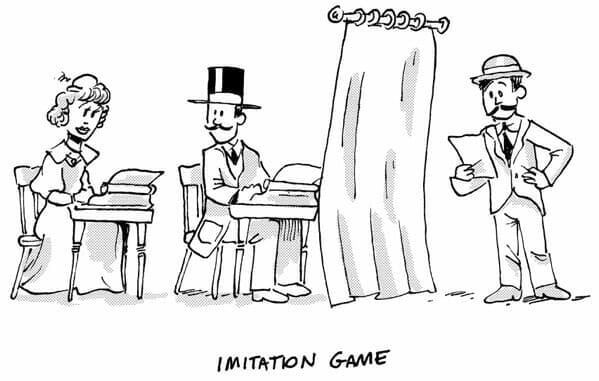
Turing imagined an updated version of the imitation game in which Player A is replaced by a machine. If the machine were just as effective as a human player in fooling Player C, Turing deemed this proof of (artificial) intelligence. The imitation game later came to be referred to as the "Turing test."
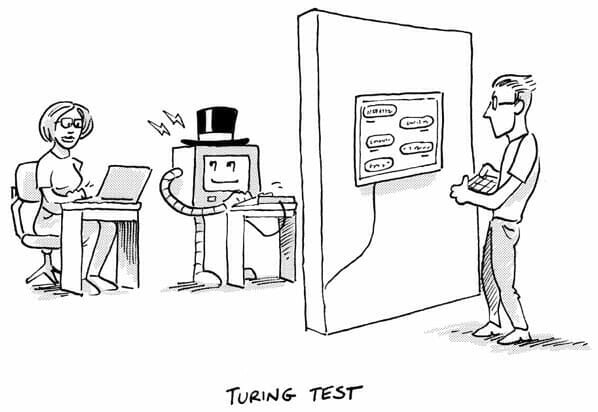
This test sparked a lot of curiosity in the possibility of an "intelligent machine." This machine could accomplish a specific task in the presence of uncertainty and variations in its environment. For a machine to be considered intelligent, it must be able to monitor its environment and make adjustments based on its observations.
In the case of the Turing test, the machine would need to be able to "understand" its role in the game (to fool Player C) and its gender (male) and be able to choose responses to unanticipated questions in a way that would confuse Player C.
Even after nearly 70 years, this test is still intriguing and a considerable challenge for computer developers. You can witness a version of this today by interacting with smartphones and artificially intelligent virtual assistants, like Siri and Alexa, whose answers to questions and responses to directives are often comical at best.
Turing Test Limitations
Most experts agree that the Turing test is not necessarily the best way to gauge intelligence. For one it depends a lot on the interrogator. Some people are more easily fooled. It also assumes that artificial intelligence is like human intelligence and that computers have mastered verbal communication, when that is far from the truth; computers often misinterpret words and phrases. If a computer cannot carry on an intelligent conversation, then how can we expect it to perform higher level tasks that require the ability to accurately interpret verbal and non-verbal communication, such as accurately diagnosing an illness?
A Test That Continues to Drive Innovation
The Turing test still inspires a lot of innovation. Companies continue to try to create intelligent chatbots, for example, and there are still natural language processing (NLP) competitions that attempt to pass the test. Indeed, it seems as though modern machines are only a few years away from passing the Turing test. Many modern NLP applications are able to accurately understand many of your requests. Now they just have to improve their ability to respond.
Yet even if a machine is able to pass the Turing test, it still seems unlikely that that same machine would qualify as intelligent. Even if your smartphone is able to trick you into thinking you’re talking to a human, that doesn’t mean that it will offer meaningful conversation or care about what you think or feel.
Frequently Asked Questions
What is the Alan Turing Test?
The Alan Turing Test comes from Alan Turing's 1950 paper "Computing Machinery and Intelligence." The test checks if a machine can act like a human. During the Turing Test, a person talks with a machine and a human. If the person can't tell which one is the machine, the machine passes the test.
What is the 'imitation game' that Alan Turing described?
The 'imitation game' described by Alan Turing involves three participants: a man, a woman, and a questioner. The questioner must determine which of the two participants is the man and which is the woman based solely on their written responses.
Turing later adapted this game format to create what is now known as the Turing Test, where the questioner must distinguish between a human and a machine.
What did Turing mean by "Can machines think?"
When Turing posed the question "Can machines think?" he was looking for the possibility of creating computer programs capable of showing intelligent behavior.
Rather than addressing the philosophical debate directly, Turing introduced the Turing Test as a practical method for evaluating whether a machine could imitate human thought and behavior convincingly.
Turing's Imitation Game and how does it relate to Artificial Intelligence (AI)?
Turing's Imitation Game is an early version of the Turing Test where a machine attempts to imitate a human in a conversation. This game set the foundation for evaluating artificial intelligence and its ability to mimic human-like thought processes and conversational skills.
What developments have occurred since the publication of Turing's paper in 1950?
Since the publication of Turing's 1950 paper, there have been numerous improvement in artificial intelligence, including:
- The creation of chatbots like ELIZA
- The introduction of the Loebner Prize competition
- the development of more sophisticated AI systems such as ChatGPT
These advancements have continued to push the boundaries of what machines can do and how convincingly they can imitate human behavior.
Could a machine actually pass a Turing Test?
While some AI systems have come close and certain chatbots have performed well in limited scenarios, the official answer is "maybe." Since the test is subjection and based on an individual's perception then it's not really something that is winnable. If you had asked my dad whether his Palm Pilot in the early 90s was intelligent he would have said "yes."
The complexity of human language and behavior makes it challenging for machines to completely mimic human responses convincingly across diverse contexts.

This is my weekly newsletter that I call The Deep End because I want to go deeper than results you’ll see from searches or LLMs. Each week I’ll go deep to explain a topic that’s relevant to people who work with technology. I’ll be posting about artificial intelligence, data science, and data ethics.
This newsletter is 100% human written 💪 (* aside from a quick run through grammar and spell check).
More sources
- https://en.wikipedia.org/wiki/Alan_Turing
- https://www.britannica.com/biography/Alan-Turing
- https://www.biography.com/scientists/alan-turing
- https://slate.com/culture/2014/12/the-imitation-game-fact-vs-fiction-how-true-the-new-movie-is-to-alan-turings-real-life-story.html
- https://screenrant.com/imitation-game-true-story-every-change/
- https://en.wikipedia.org/wiki/Turing_test
- https://www.investopedia.com/terms/t/turing-test.asp
- https://www.nexlogica.com/exploring-the-pros-and-cons-of-the-turing-test/
- https://fastercapital.com/topics/the-limitations-of-the-turing-test.html
- https://theconversation.com/ai-is-closer-than-ever-to-passing-the-turing-test-for-intelligence-what-happens-when-it-does-214721
- https://physicsworld.com/a/the-turing-test-2-0/
- https://spectrum.ieee.org/turing-test
- https://www.livescience.com/technology/artificial-intelligence/gpt-4-has-passed-the-turing-test-researchers-claim
- https://cointelegraph.com/news/vitalik-buterin-gpt-4-passed-artificial-intelligence-turing-test
- https://www.aei.org/workforce-development/did-ai-just-pass-the-turing-test/