


Artificial intelligence and organizations are not always a great fit. While many organizations use artificial intelligence to answer specific questions and solve specific problems, they often overlook its potential as a tool for exploration and innovation. The use AI to look for patterns in data that they probably would not have noticed on their own.
In these organizations, the focus is on supervised learning. This is training machines to recognize associations between inputs and labels or between independent variables and the dependent variable.
These organizations spend less time, if they spend any time at all, on developing AI in collaboration with stakeholders. They also might use unsupervised learning. That's when you feed an artificial neural network large volumes of data to find out what the machine discovers in that data.
Observe and Question

With supervised learning, data scientists are primarily engaged in a form of programming, but instead of writing specific instructions in computer code, they develop algorithms that enable machines to learn how to perform specific tasks on their own. Like software they get the most from the system after a period of training and testing.
To get the most from AI you usually have to have well organized data science teams. Data science is much more than merely training machines to perform specific tasks. To achieve the full potential of data science, organizations should place the emphasis on science and apply the scientific method to their data:
- Observe
- Question
- Research
- Hypothesize
- Experiment
- Test
- Draw conclusions
- Report
The first step in the scientific method is to observe. This step is often overlooked by data science teams. They start using the data to drive their supervised machine learning projects before they fully understand that data.
Unsupervised learning is an excellent tool for conducting data science, because it can analyze volumes of data far beyond the capabilities of what humans can analyze, it looks at the data objectively, and it provides a unique perspective on that data often revealing insights that data science team members would never have thought to look for.
Note that the second step in the scientific method is to question. Unfortunately, many organizations skip this step, usually because they have a deeply ingrained control culture. Such organizations would be wise to change from a control culture to a culture of curiosity. This is a culture where people on all levels ask interesting questions and challenge long-held beliefs.
Enhancing Efficiency With Artificial intelligence

Using AI in your business helps things run smoother and faster. It does this by taking over simple, repeat tasks and cutting down on mistakes made by people.
When AI handles tasks like entering data, managing schedules, and answering customer questions, your team can focus on the important work. This means work gets done quicker and more efficiently, which helps your business work better.
For example, think of AI as a helpful tool that does boring jobs quickly. This leaves your team free to tackle bigger projects that help grow your business. By using artificial intelligence, your business becomes more flexible and ready to meet new challenges. This change can make your business stronger and more competitive.
AI-Driven Decision-Making

AI adoption in decision-making helps companies make smart choices on a quicker way. AI is able to compute and analyze large amounts of data in just a few seconds, spotting important patterns and trends that might be missed otherwise, illustrating the use of AI in uncovering insights. This improves how you make decisions and keeps you ahead in your business field.
AI tools let you adapt fast to changes in the market. This helps you make clear, strategic choices that move your company forward. AI helps to make decisions, you're not just keeping up with others; you're staying in front. You use accurate information to guide your company's direction.
AI helps you see what's important in a big pile of data. It helps you decide faster and better, giving your company a lead over others, thanks to the strategic use of AI technologies.
Predictive Analytics Impact
Predictive analytics is a tool that helps businesses know what their customers might do next. It looks at old data to predict future trends. This helps companies get ready and make smart choices early. This tool tells you what your customers might want before they even ask for it.
A store can use predictive analytics to figure out what products will sell best next month. This means they can order just the right amount of stock, not too much or too little. They can also create ads that talk directly to what customers feel and want. This makes customers happy because they see products they like.
If businesses start using predictive analytics, they can become more proactive and smart about data.
This change can make a big difference in staying ahead in the market.
Trust and Ethics in AI
Building trust and using AI ethically is important to ensure that everyone believes in it and uses it the right way in businesses.
To do this, you need to set up clear rules that say what's okay and what's not. This makes sure AI works fairly.
Being open about how AI makes decisions is very important. It helps everyone understand what the AI does, giving more trust. This also helps fix any unfairness in how AI works.
AI Applications in Business
Once you make sure AI is used wisely you can use it to change the way businesses work. AI can make your marketing better by grouping customers and automating marketing tasks. This helps you reach the right people with the right messages, boosting interest and sales.
Here's how AI can change your business:
1. Customer Segmentation: AI can sort your customers into different groups. This helps you send marketing messages that are right for each group.
2. Marketing Automation: AI can do regular marketing jobs like sending emails on its own. This saves you time and effort.
3. Predictive Analytics: AI can use data to guess future trends, demonstrating the practical application of AI systems in forecasting. This helps you make smart choices for your business.
These tools help you understand your customers better and respond more effectively, making your business stronger and more responsive.
People-Centric AI Approach
Adopting a people-first AI approach ensures that human skills and viewpoints are key to an organization's success. This method puts people first, highlighting the importance of growing our workforce. By letting employees work with AI, we create an environment where technology supports human abilities. It's key to mix automation with efforts that create new jobs and improve skills.
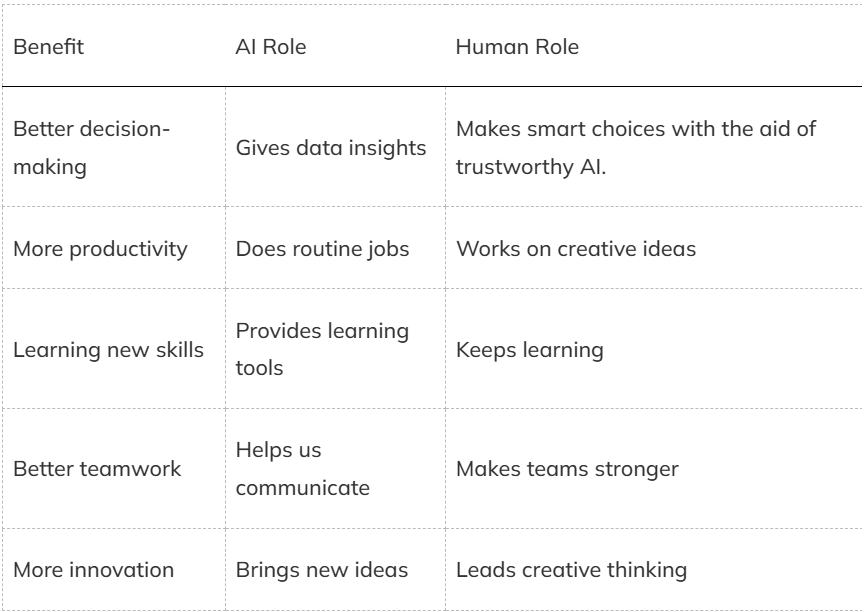
This way, we make sure that AI joining the team helps everyone.
Nurturing a Culture of Curiosity
People are naturally curious, but in some organizations, employees are discouraged from asking questions or challenging long-held beliefs. In organizations such as these, changing the culture is the first and most challenging step toward taking an exploratory approach to artificial intelligence, but it is a crucial first step. After all, without compelling questions, your organization will not be able to reap the benefits of the business insights and innovations necessary to remain competitive through ai research.
A couple ways to encourage personnel to start asking interesting questions through the lens of AI technologies and stakeholder engagement.
- Conduct question meetings. The sole purpose of the question meeting is to ask interesting and relevant questions and call attention to problems. Do not try to answer questions or solve problems during the meeting. Ban all cell phones and other electronic devices, and have your research lead conduct the meeting.
- Place a question board in a well-trafficked area. A question board invites people to post questions and problems and provides inspiration for additional questions. In large organizations, consider posting multiple question boards, so everyone can participate.
Another way to encourage curiosity is to reward personnel for asking interesting questions and, more importantly, avoid discouraging them from doing so. Simply providing public recognition to an employee who asked a question that led to a valuable insight is often enough to encourage that employee and others to keep asking great questions.
The takeaway here is that you should avoid the temptation to look at artificial intelligence as just another project. You don’t want your data science teams merely producing reports on customer engagement, for example. You want them to also look for patterns in data that might point the way to innovative new ideas or to problems you weren’t aware of and would never think to look for.
Frequently Asked Questions
What are the key considerations for organizations when adopting AI initiatives?
When you adopt AI projects, you have to think about a few key things. First, make sure your AI projects match your goals. Next, check if your tech setup can handle AI tools. Finally, make sure you have skilled people to run these AI systems.
An interesting fact is that companies with clear goals for AI often see better results. They know what they want to achieve, and they plan well.
How can organizations ensure their AI policy supports ethical AI use?
To make sure their AI policies are ethical, groups should follow some key ideas. These ideas include being open, being responsible, being fair, and protecting privacy.
Talk to experts from schools, community groups, and public leaders. They can give helpful advice and ideas.
It's important to check and update the policy often. This helps keep up with new AI changes and ethical needs.
In what areas does AI have the most impact within organizations?
AI helps a lot in many areas. Let's look at some examples.
In customer service, AI-powered chatbots talk to people. They give answers and help with problems. AI also gives personal tips and suggestions.
In operations, AI makes logistics and supply chains work better. It helps plan and manage everything smoothly.
In marketing, AI studies how people behave. It gives useful insights. This helps to make good decisions.
In human resources, AI makes hiring and keeping employees easier. It helps find the right people and keeps them happy at work.
AI also helps in research and development. It speeds up new ideas and makes work more efficient.
How important is the role of data in implementing AI?
Data is very important for using AI. Most AI tools need lots of different data to work well.
So, a good plan for handling data is a must. This plan should keep data clean, private, and well-managed. With good data, you help AI learn and make smart predictions.
What is the importance of a multidisciplinary approach in AI research and development?
You need many skills to research and develop artificial intelligence.
AI technologies are complex and have many effects. You should mix knowledge from computer science, ethics, psychology, and specific job fields.
This mix helps you understand AI's possibilities and problems better.
You can create AI systems that are advanced, fair, and good for society. Join a scientific group focused on AI and its impacts to support this wide-ranging approach.
What challenges do organizations face in the adoption of AI?
Organizations have a tough time with AI. First, they need to invest a lot in new tech and smart people. They have to integrate AI into their old ways of doing things. They also need to ensure data security and privacy.
Then, they must keep learning because AI changes fast. People in the company often don't like changes. The bosses have to ensure AI projects adhere to the rules and are beneficial for everyone.

This is my weekly newsletter that I call The Deep End because I want to go deeper than results you’ll see from searches or LLMs. Each week I’ll go deep to explain a topic that’s relevant to people who work with technology. I’ll be posting about artificial intelligence, data science, and ethics.
This newsletter is 100% human written 💪 (* aside from a quick run through grammar and spell check).
MORE SOURCES:
- https://www.bdodigital.com/insights/analytics/strategies-for-expanding-ai-initiatives-across-your-organization
- https://www.dnv.com/research/future-of-digital-assurance/building-trust-in-ai/
- https://www.oecd.org/science/forty-two-countries-adopt-new-oecd-principles-on-artificial-intelligence.htm
- https://www.shellye.opengrowth.com/article/the-role-of-ai-in-modern-management-challenges-and-opportunities
- https://www.eficio.ca/en/blog/implementation-of-an-artificial-intelligence-program/
- https://thedataprivacygroup.com/blog/building-trust-in-ai/
- https://amaris.com/insights/news/ai-companions-in-business-practices/
- https://hbr.org/2024/01/turn-generative-ai-from-an-existential-threat-into-a-competitive-advantage
- https://transcend.io/blog/enterprise-ai-governance
- https://www.elev8me.com/insights/top-applications-of-artificial-intelligence-for-businesses
- https://waverleysoftware.com/blog/ai-strategy-for-business/
- https://hbr.org/2020/08/the-secret-to-ai-is-people