


Expert systems and machine learning are different approaches to artificial intelligence. The difference between the two boils down to how structured they are:
- An expert system is highly structured to simulate the steps and decision-making processes an expert in a specific field follows to perform tasks and make decisions.
- Machine learning is less structured but more complex, allowing the machine to make data-driven decisions, instead of telling it specifically what to do and how to do it.
Expert System Components
Building an expert system requires the close collaboration of a human expert, a knowledge engineer, and a programmer. Together, they develop the three key components of the expert system:
- Knowledge base: The human expert and knowledge engineer develop a knowledge base of everything the expert knows to better understand how the expert performs tasks and makes decisions. The knowledge base contains both factual information and heuristics — rules of thumb that enable the expert to solve problems and answer questions more quickly.
- Inference engine: The inference engine contains various logical methods for drawing conclusions or making predictions. For example, an expert system designed to simulate the diagnostic process may contain a series of if-then statements that determine a patient's most likely diagnosis based on his or her symptoms.
- User interface: The user interface consists of the hardware and software that enable a user of the expert system to interact with it using, for example, a keyboard, mouse, microphone, monitor, and speakers.
Expert systems are useful when the steps for performing a task are finite and sequential and when it is possible to extract the requisite knowledge and skills from the human expert. (Experts are not always able to relate all they know in a highly structured and complete way.)
The Machine Learning (ML) model

When the solution to a problem involves more variability and uncertainty, machine learning is often a better choice over an expert system. Instead of developing a structured process for solving a problem, you simply feed a large volume of relevant data into the machine and allow it to figure out a way to solve the problem.
For example, suppose you want to create a system that detects and blocks computer viruses. If it were an expert system, it might contain a large database of virus signatures (identifiers) along with rules for comparing incoming files to those signatures and determining which files to block. However, new viruses are constantly being developed and deployed, so the database would require regular updates from a developer.
Another approach would be to use machine learning. You would feed the machine hundreds or even thousands of files infected with viruses, and it would learn to identify patterns in those files that were characteristic of viral infections. When new viruses were developed, the machine would then be able to identify most of them based on the similarity of their patterns to previously identified viruses.
A Simple Analogy

Think about the difference between an expert system and machine learning in terms of the difference between older and newer automated phone systems.
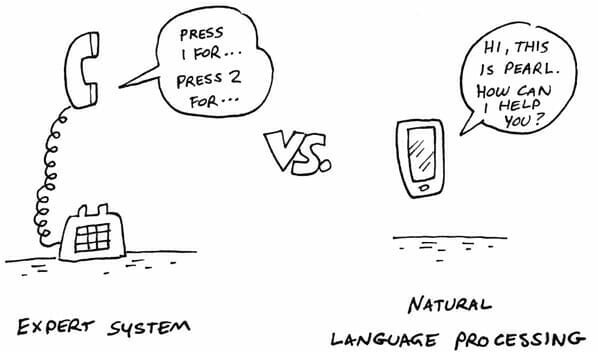
Older phone systems are sort of like expert systems; a message tells the caller to press 1 for sales, 2 for customer service, 3 for technical support, and 4 to speak to an operator. The system then routes the call to the proper department based on the number that the caller presses.
Newer, more advanced phone systems use natural language processing (NLP). When someone calls in, the message tells the caller to say what they’re calling about. A caller may say something like, “I’m having a problem with my Android smart phone,” and the system routes the call to technical support. If, instead, the caller said something like, “I want to upgrade my smartphone,” the system routes the call to sales.
If you tried to build an expert system that functioned like one of the newer systems, you would have to manually input all the possible customer statements and questions and link each to a certain action (such as route the call to technical support), and the system would still run into trouble when a caller mumbled or spoke with an accent or had a question that the expert and knowledge engineer had not anticipated.
A machine learning system is better able to handle the variation and uncertainty, because it is allowed to analyze and process a much wider variety of possible inputs. When an angry caller dials in and says something like “That smart phone I bought from you guys three days ago is a piece of junk,” the machine learning system can draw from its vast collection of words and phrases to infer the meaning of the question and route the caller to the correct department.
Learning from Its Mistakes
Now, suppose the machine learning system makes a mistake. A customer calls in and says, “I hate my new smart phone and want to return it!” The system mistakenly routes the call to sales instead of customer service. The person in sales (an intelligent human being) quickly identifies the mistake and transfers the call to customer service. This provides the machine learning system with an important input. It learns that the next time someone calls and mentions the word "return," the call should be routed directly to customer service, not to sales.
When you are working on a team that is trying to decide which approach is better for a specific application (an expert system or machine learning) keep in mind the key differences between the two. If you can draw a decision tree or flow chart to describe a specific task the computer must perform based on limited, clearly defined inputs, then an expert system is probably the best choice. It may be easier to set up and deploy, saving you time, money and the headache of dealing with a more complex system. If, however, you’re dealing with massive amounts of data and a system that must adapt to changing inputs, then machine learning is probably the better choice.
Some AI experts mix these two approaches. They use an expert system to define some constraints and then use machine learning to experiment with different answers. So you have three choices — an expert system, machine learning or a combination of the two.
Frequently Asked Questions
Does Expert Systems mimic human expertise in AI?
Yes! An expert system is a computer program that mimics human expertise in a specific domain to solve complex problems.
Expert systems are relatively straightforward and use a set of rules based on domain-specific human knowledge to make decisions. Examples of expert systems include medical diagnosis systems and troubleshooting programs.
What is Machine Learning in AI?
Machine Learning is a subset of AI that involves training algorithms on data to learn patterns and make predictions.
Unlike expert systems, which follow predefined rules, machine learning algorithms can adapt and improve from experience. Types of machine learning include supervised learning, unsupervised learning, and reinforcement learning.
How do Expert Systems and Machine Learning differ?
The primary difference lies in their approach to problem-solving.
Expert systems rely on predefined rules and human expertise, while machine learning algorithms use data to learn and adapt.
Expert systems are often rigid but excellent for specific tasks, whereas machine learning can handle more dynamic and complex problems through training and experience.
What are the key components of an Expert System?
The main components of an expert system include the Knowledge Base, which contains domain-specific information, the Inference Engine, which applies rules to data in the knowledge base to make decisions, and the User Interface, which allows users to interact with the system.
What role do neural networks play in AI?
Neural networks are a cornerstone of deep learning and a type of machine learning algorithm. They are designed to recognize patterns, process data, and make decisions in a way that mimics the human brain. Neural networks are particularly effective for tasks like image and speech recognition.
What are the advantages of Expert Systems?
Advantages of expert systems include consistency in decision-making, preservation and sharing of domain-specific human knowledge, and the ability to handle large volumes of information efficiently. They are particularly useful in domains where human expertise is scarce.
How is Deep Learning different from traditional Machine Learning?
Deep learning is an advanced form of machine learning involving neural networks with multiple layers. While traditional machine learning relies on manually crafted features, deep learning can automatically discover representations in data, making it powerful for complex tasks like image and natural language processing.
What are the key benefits of using Machine Learning in AI over Expert Systems?
The key benefits of machine learning include its ability to handle large and complex data, adaptability through continuous learning, and superior performance in tasks such as predictive modeling and generative AI. Unlike expert systems, machine learning models can evolve and improve as they are exposed to more data.
What are the main differences between Expert Systems and Machine Learning in AI?
Expert Systems in AI use predefined rules and human expertise to solve complex problems, while Machine Learning (ML) involves creating algorithms that enable systems to learn from data. Expert Systems are relatively static, focusing on specific domains, whereas ML algorithms adapt over time based on new data.
What are the key components of an Expert System?
An expert system is a computer program comprising a knowledge base, inference engine, and user interface. The knowledge base contains domain-specific information, the inference engine processes this information, and the user interface allows interaction with the user.
What is Generative AI, and how is it different from other types of AI?
Generative AI refers to algorithms that can create new data instances similar to the data they were trained on. Unlike traditional AI, which typically focuses on problem-solving and decision-making, generative AI can produce new content, such as text, images, or music, driven by pattern recognition.

This is my weekly newsletter that I call The Deep End because I want to go deeper than results you’ll see from searches or LLMs. Each week I’ll go deep to explain a topic that’s relevant to people who work with technology. I’ll be posting about artificial intelligence, data science, and data ethics.
This newsletter is 100% human written 💪 (* aside from a quick run through grammar and spell check).
More sources
- https://www.freecodecamp.org/news/pytorch-vs-tensorflow-for-deep-learning-projects/
- https://www.datasciencesociety.net/pythons-role-in-shaping-the-future-of-ai-and-machine-learning/
- https://www.dataversity.net/brief-history-data-science/
- https://www.simplilearn.com/keras-vs-tensorflow-vs-pytorch-article
- https://en.wikipedia.org/wiki/Data_science
- https://towardsdatascience.com/pytorch-vs-tensorflow-in-code-ada936fd5406?gi=774c87eb5137
- https://onlinestemprograms.wpi.edu/blog/history-data-science-and-pioneers-you-should-know
- https://builtin.com/data-science/pytorch-vs-tensorflow
- https://opencv.org/blog/pytorch-vs-tensorflow/
- https://www.globaltechcouncil.org/python/python-popularity-and-versatility/
- https://www.datacamp.com/tutorial/pytorch-vs-tensorflow-vs-keras
- https://onix-systems.com/blog/python-is-best-for-ai-ml-and-deep-learning
- https://stackify.com/tensorflow-vs-pytorch-which-deep-learning-framework-is-right-for-you/
- https://www.codetoday.co.uk/post/the-relationship-between-coding-in-python-and-ai
- https://realpython.com/pytorch-vs-tensorflow/